Defensible Space Assistance Program

Defensible Space
The creation and regular maintenance of Defensible Space around your home will help to significantly reduce damage to your home and property in the event of a catastrophic wildfire. You can implement defensible space by reducing flammable items and vegetation within 100 feet of your house and other structures.
ARCD Defensible Space Assistance Pilot Program:
Opens May 13, 2026
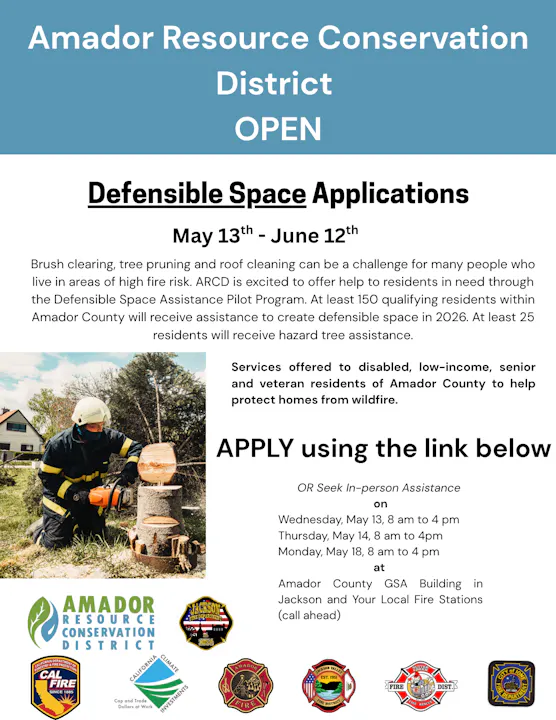
Brush clearing, tree pruning and roof cleaning can be a challenge for many people who live in areas of high fire risk. ARCD is excited to offer help to residents in need through the Defensible Space Assistance Pilot Program. At least 150 qualifying residents within Amador County will receive assistance to create defensible space in 2026. At least 25 residents will receive hazard tree assistance. Please read and review the information on this page before submitting your application.
Click the "Apply Here" button at the bottom to fill out the Defensible Space Application.
Town Hall Meeting
When: Monday, May 11th
Where: Board of Supervisors Chamber, Amador County Administration Building
810 Court Street, Jackson, 6:00 pm
Application Dates
Opens: Wednesday, May 13th, 8AM
Closes: Friday, June 12th, 4 PM
In-person Application Assistance
When: Wednesday, May 13th; Thursday, May 14th; and Monday, May 18th, 8 AM to 4 PM
Application Responses, Sent by ARCD
When: Wednesday, June 24th or before
Defensible Space and Hazard Tree Assessments, for approved applications
When: June through August
Treatment Implementation, for approved applications
When: June through November
Who is eligible to apply?
- The applicant's primary residence is within Amador County.
- The applicant may be the homeowner or a renter. If the applicant is not the homeowner, the applicant must communicate with the property owner, who must agree to the terms of the program and sign consent forms before assessments are scheduled.
- The applicant identifies with at least one of the following eligibility categories:
| Applicants May Be Asked to Present Documents at the Initial Property Assessment in Order to Qualify for Assistance | Examples of Qualifying Documents (not an exhaustive list) | |
|---|---|---|
| Disabled | Disabled Parking Placard | |
| Low Income | Combined annual income of all members of the household is - 80% or less of the median income (gross) for Amador County in 2025. See "Low-Income Threshold Table." | Latest paystub, tax returns or valid SNAP EBT card |
| Senior | Aged 60 or over | Driver's License or other identification |
| Veteran | Active-Duty military, Reserves and National Guard are also eligible | DoD identification card, Veteran Health identification card, Veteran ID card or Veteran's designation on driver's license or ID |
Low-Income Threshold Table
| No. of People in Household | Low Income Threshold (Annual) |
|---|---|
| 1 | $61,550 |
| 2 | $70,350 |
| 3 | $79,150 |
| 4 | $87,900 |
| 5 | $94,950 |
| 6 | $102,000 |
| 7 | $109,000 |
| 8+ | $116,050 |
Want to learn more about the income levels distinctions? Please see the State of California's Department of Housing and Community Development (HUB) 2025 State Income Limits Memo.
In order to complete the application efficiently, please have the following information at your fingertips:
- Assessors Parcel Number (APN) of your property. You can find your APN through the Amador County Assessor’s webpage, click on the tab “Lookup Parcels, Values and Maps”, and enter your address. You can also find your APN on real estate documents such as the Title to your property.
- Verify that you qualify for assistance through at least one of the four eligibility categories.
- Determine whether you are interested in Defensible Space Assistance, Hazard Tree Assistance, or both. Review the descriptions of each service below.
- Indicate the hazardous conditions and other operational considerations that exist on your property: including poison oak, steep terrain, tall structures, dogs, livestock, and restricted lot size.
- Measure or estimate the height of your roof from the lowest and highest access points.
- Decide if you would like to request the Good Neighbor Policy to apply treatment on up to three neighbors’ properties within 100 feet of your house. Have a conversation with the owner(s) of each property and request their permission to be included in the application. Know the name, address, APN, email and phone number for each one.
If you meet the eligibility requirements and you have all the information outlined above, complete the online application linked at the bottome of this page.
Right of Entry
The applicant, property owner (if different from the applicant), and Good Neighbors (See Frequently Asked Questions below) must provide consent through a Right of Entry Form. The digital Right of Entry form is linked at the end of the online application and will be sent by email to property owners and Good Neighbors included in the application. Alternatively, paper Right of Entry forms can be signed at the beginning of the Assessment.
How will my application be evaluated?
ARCD staff will review applications to ensure completeness and eligibility for the program. All applicants will receive a response from ARCD on or before June 24th, 2026. Applications will be selected on a first-come, first-served basis. The first 150 complete Defensible Space Assistance applications from eligible applicants will be selected to receive a Defensible Space Assessment. The first 40 complete Hazard Tree Assistance applications will be selected to receive a Hazard Tree Assessment. Among those 40, the 25 trees that present the highest risk of damaging a house or propane tank will be selected for treatment.
If funds remain after assistance is provided to the first 150 Defensible Space applicants, ARCD will consider the next 50 applications in the order that they were received during the original application window. Similarly, if funds remain after assistance is provided to the first 25 Hazard Tree applicants, ARCD will consider the next 15 trees that present the highest risk to structures. ARCD will assign the additional Assessments in September 2026 or before, and additional assistance will be offered dependent upon the remaining funding.
How is a Defensible Space Assessment conducted?
ARCD will assign your local Fire Department to schedule a Defensible Space assessement with you. Once scheduled, you and each of your neighbors participating in your application through the Good Neighbor Policy will receive an email notifcation. You (the applicant) or someone you designate must be present for the Assessment. Your Fire Department Assessor will evaluate the space within 100 feet of your house according to Defensible Space standards established by CALFIRE. They will note what items need attention and will assign items to the Contractor through annotated photographs. You will receive a paper copy of the Assessment, which is a checklist of items, and after your Assessor enters the information into the ARCD system, you may request an emailed copy of their notes and photographs.
How is a Hazard Tree Assessment conducted?
ARCD will assign our contracted Registered Professional Forester (RPF) to schedule a Hazard Tree Assessment with you. Once scheduled, you will receive an email notification. You (the applicant) or someone you designate must be present for the Assessment. The RPF will assess each tree that is within striking distance of the house and rank them by priority to remove according to United States Forest Service guidelines. You will receive a paper copy of the Assessment, and after your Assessor enters the information into the ARCD system, you may request an emailed copy of their notes and photographs.
How will the Assessment(s) determine eligibility for Assistance?
Your Assessor may ask to see documents reflecting eligibility through one of the categories listed above: disabled, low income, disables or veteran. Applicants may be disqualified for assistance if they cannot provide such proof of eligibility.
ARCD anticipates that nearly all, if not all of the first 150 applicants who are selected to receive a Defensible Space Assessment and who meet the eligibility requirements will receive Assistance. The exception would be if no work is recommended. If the Fire Department Assessor determines that the property meets Defensible Space standards for all the items that this program offers assistance for, then no assistance will be assigned.
Of the 40 applicants who are selected to receive a Hazard Tree Assessment, the 25 trees that present the highest risk of damaging a house or propane tank will be selected for treatment.
Do I have to be present for the Assessment(s)?
You or someone who you designate must be present for the assessment. They last approximately 30 minutes each.
What defensible space services are offered?
The ARCD DSPACE program will assist residents to create and maintain defensible space. This program does not guarantee compliance with California Public Resources Code 4291 which defines standards for property owners in the State Responsibility Area (SRA). The ARCD DSPACE program will perform a defensible space assessment on the applicant’s home that will determine which types of vegetation treatment apply among the list below. Services will be performed up to a maximum dollar value of assistance per household, after which the applicant may hire additional services or seek additional assistance beyond this program. Services will be prioritized closest to the home and progress out toward the 100-foot limit as time and budget allow.
Services Included:
- Cut or prune shrubs and trees up to 10” Diameter at Breast Height (DBH) within 100 feet of the house, removing all dead and dying plants.
- Clear vegetative debris (branches, leaves, pine needles and cones) from the roof, gutters, underneath decks, balconies and stairs
- Chip all material cut
- Clear vegetative debris and wee-eat in Zone 0: up to 5 feet from the house (including balconies).
- Ensure that vegetative debris does not exceed a depth of 3 inches in Zones 1 and 2: between 5 and 100 feet from the house.
- Relocate exposed wood piles to Zone 2: 30 feet from the house
- Process downed logs into 16” rounds and relocate 30 feet from the house
Services not included:
- Mow grass or other herbaceous vegetation requiring regular maintenance.
- Rake/blow leaves beyond 5 feet from house
- Home Hardening, or any activity involving structural alterations to the house, decks, fences, or other structures.
- Haul material off the property. Exceptions may be made for situations where there is not enough room on the property to accommodate chipped material.
What Hazard Tree services are offered?
Dead, dying or diseased trees larger than 10” DBH which are within striking distance of a house may qualify for removal. Services will be performed up to a maximum dollar value of assistance per household to treat from one to several trees, depending on the labor required to fell and process each tree. Hazard tree assistance will be provided independently of Defensible Space assistance, that is, the maximum dollar value of assistance for each type of service is separate and may be applied on the same property.
Who is going to perform the work?
Alta Vista Landscaping and Tree Service is an experienced local contractor specializing in Defensible Space landscaping and tree care. Alta Vista is one of several contractors partnered with the El Dorado County Fire Safe Council to implement their Defensible Space Assistance Program since 2022 and have since helped hundreds of residents to prepare their homes for wildfire. Alta Vista has an excellent reputation with its customers and with their organizational partners; ARCD considers itself very lucky to be working with them!
How can I ensure that my property will be protected while the work is being performed?
ARCD works with experienced contractors who take the utmost care of the properties they work on. If any damage were to occur to your property, the contractor would be responsible for fixing it. Fencing that is moved/dropped during operations will be put back up. Minor alterations that are inherent to the type of work performed will not be considered “damage” to be fixed or compensated for, including but not limited to minor tracks left on lawn or soil, skin-ups to the bark of trees, or some broken branches.
After your home is assessed and approved for assistance, you may call 811 to have your underground utility lines marked if you have any concern that underground utility lines could be affected by the treatment.
1. What if I need help with the application?
ARCD staff, partner Fire Protection Districts and City Fire Departments will hold in-person office hours for help with applications. No need to make appointments during the office hours:
Where
- General Services Administration Building (ARCD office), 12200 B Airport Road, Jackson, CA 95642.
- Jackson City Hall, 33 Broadway, Jackson, CA 95642
- Jackson Valley Fire Protection District, 2701 Quiver Drive, Ione, CA 95640
When
Wednesday, May 13th; Thursday May 14th; and Monday, May 18th
If you need help to fill in the application by phone or in person outside of the office hours listed above, please contact:
Cailin McLaughlin, Outreach and Admin Coordinator
(209) 214-9727
applications@amadorrcd.org
2. What if the vegetation on my neighbor’s property poses a danger to my house?
A homeowner is legally only responsible for maintaining defensible space up to 100 feet from structures on their own property. However, the 100-foot zone of influence still has an impact on a house’s wildfire preparedness even when it extends onto a neighbor’s property.
Good Neighbor Policy
You may request assistance to treat the area on your neighbor’s property within 100 feet of your house at the same time as your own. This extended assistance will be made possible with documented support from your neighbor who will receive notifications about each step of the assistance process along with the applicant. You must communicate with the neighbor about the assistance, and the neighbor must sign written consent forms before assessments are scheduled. If you request treatment on your neighbor's property at the application stage, but that neighbor does not sign consent forms, your application will still be considered for your property without your neighbor's.
3. What happens if I am not selected to receive an Assessment?
ARCD has limited funds to apply to this year’s Pilot Program. If future funding becomes available, ARCD would open applications again. This year’s applicants would need to submit another application to be considered. ARCD encourages anyone interested in future programs to stay informed by signing up for the ARCD mailing list (click the “Join our mailing list” icon on the bottom right of the screen).
If you would still like to receive a Defensible Space Assessment for your own information, contact your local Fire Department to request one. Make sure to contact the appropriate Fire Department according to where you live:
Amador Fire Protection District
City of Ione Fire Department
City of Jackson Fire Department
Jackson Valley Fire Protection District
Sutter Creek Fire Protection District
You can also learn more about Defensible Space, Home Hardening and Fire-Smart Landscaping online and conduct a self-assessment.
ARCD is looking forward to re-opening Community Chipping Events in fall 2026, which will help process residents’ green waste from their properties which they cut themselves. To stay informed about how to participate in that program, sign up for the ARCD mailing list. Community Chipping Events are available to all residents of Amador County regardless of age, income, disability or veteran status.
4. Is the Rights of Entry persistent or only for the scope of this Defensible Space Program?
The Rights of Entry (ROE) are not persistent and only applies for use by the approved assessors and contractors for this 2026 Defensible Space Assistance Program.
5. How long will the Assessment take?
The Assessment should take about 30 minutes, give or take.
6. If I do not have access to a computer or internet, how can I fill out the application beyond the offer three day in-person assistance?
If you do not have access to a computer or internet at home and you cannot make it to any of the in-person assistance days, you can call (209) 214-9727. This will connect you with an ARCD staff member who can fill out the application for you, provided you consent to providing the neccessary information.
If you fill out the application this way you will need to sign a paper copy of the Rights of Entry (ROE) before the Assessment is conducted.
7. Mowing is not one of the services being offered, but what about weed whacking the vegetation if is in Zone 0 and up to 5 feet from my house?
Clearing of vegetative debris in Zone 0, up to 5 feet from the house (including balconies) are services being offered by this program.
Defensible Space Assistance Program PowerPoint Presentation
ARCD Defensible Space Application Release.pdfHow is this program funded?
The ARCD Defensible Space Assistance Pilot Program is funded through a CALFIRE Wildfire Prevention Grant.
Will the Defensible Space Assistance Program be offered beyond 2026?
ARCD intends to continue the Defensible Space Assistance Program in future years by seeking additional grant funding opportunities.
*2026 APPLICATION PERIOD IS CLOSED*
Questions?
Contact
Cailin McLaughlin, Outreach and Admin Coordinator
(209) 214-9727
info@amadorrcd.org